What Is a Reflow Oven? Essential Guide for SMT Assembly Success
At I.C.T, we understand that a surface mount reflow oven is the cornerstone of modern electronics manufacturing, enabling precise soldering for high-quality printed circuit board (PCB) assemblies. These specialized ovens heat solder paste to create strong, reliable connections between components and PCBs in surface mount technology (SMT) processes. With decades of experience as a leading reflow oven manufacturer, we’ve seen firsthand how these machines drive efficiency and quality in production lines. This guide dives into what a reflow oven is, how it works, its types, key features, and why it’s indispensable for SMT success, drawing on our expertise and industry insights.
1. Understanding the Role of Reflow Ovens in SMT

1.1. Defining a Reflow Oven in PCB Assembly
A reflow oven is a machine designed to melt solder paste, bonding electronic components to PCBs during SMT assembly. Unlike traditional soldering methods, reflow ovens use controlled heat to create consistent, high-quality solder joints across complex circuit boards. At I.C.T, we design our ovens to handle diverse PCB sizes and component types, ensuring reliability for industries like consumer electronics, automotive, and telecommunications. According to report, reflow soldering accounts for over 80% of SMT assembly due to its precision and scalability.
1.2. Why Reflow Ovens Are Critical for SMT Success
Reflow ovens are vital because they automate and standardize the soldering process, reducing human error and boosting throughput. They ensure uniform heating, which is essential for densely populated PCBs with tiny components like microchips or resistors. Our experience at I.C.T shows that a well-calibrated PCB Soldering Oven can cut defect rates by up to 30%, saving manufacturers time and costs. This precision is why reflow ovens are non-negotiable in modern SMT lines.
2. How Reflow Ovens Work

2.1. The Reflow Soldering Process Explained
The reflow soldering process involves applying solder paste—a mix of powdered solder and flux—onto a PCB’s pads, placing components, and then passing the board through a reflow oven. The oven heats the assembly in stages to melt the solder and form strong joints. At I.C.T, we’ve optimized our ovens to follow a precise thermal profile: preheating, soaking, reflow, and cooling. This ensures components are not thermally shocked, preserving their integrity.
2.2. Temperature Zones and Their Functions
Reflow ovens are divided into temperature zones, each serving a specific purpose. Typically, an oven has 6–12 heating zones and 1–3 cooling zones. Preheating zones gradually raise the PCB temperature to activate the flux, soaking zones stabilize the temperature to prevent defects, and reflow zones melt the solder at peak temperatures (around 240–260°C for lead-free solder). Cooling zones solidify the joints. Our I.C.T ovens, like the Lyra733N, feature up to 10 heating zones for precise control, ensuring consistent results across high-volume production.
2.3. The Role of Solder Paste in Reflow Soldering
Solder paste is the glue that holds SMT together. It consists of metal alloy particles (like tin-silver-copper) suspended in flux, which cleans surfaces and prevents oxidation during heating. At I.C.T, we’ve seen how the right paste, paired with a well-tuned reflow oven, minimizes defects like tombstoning or solder bridging.
3. Types of Reflow Ovens
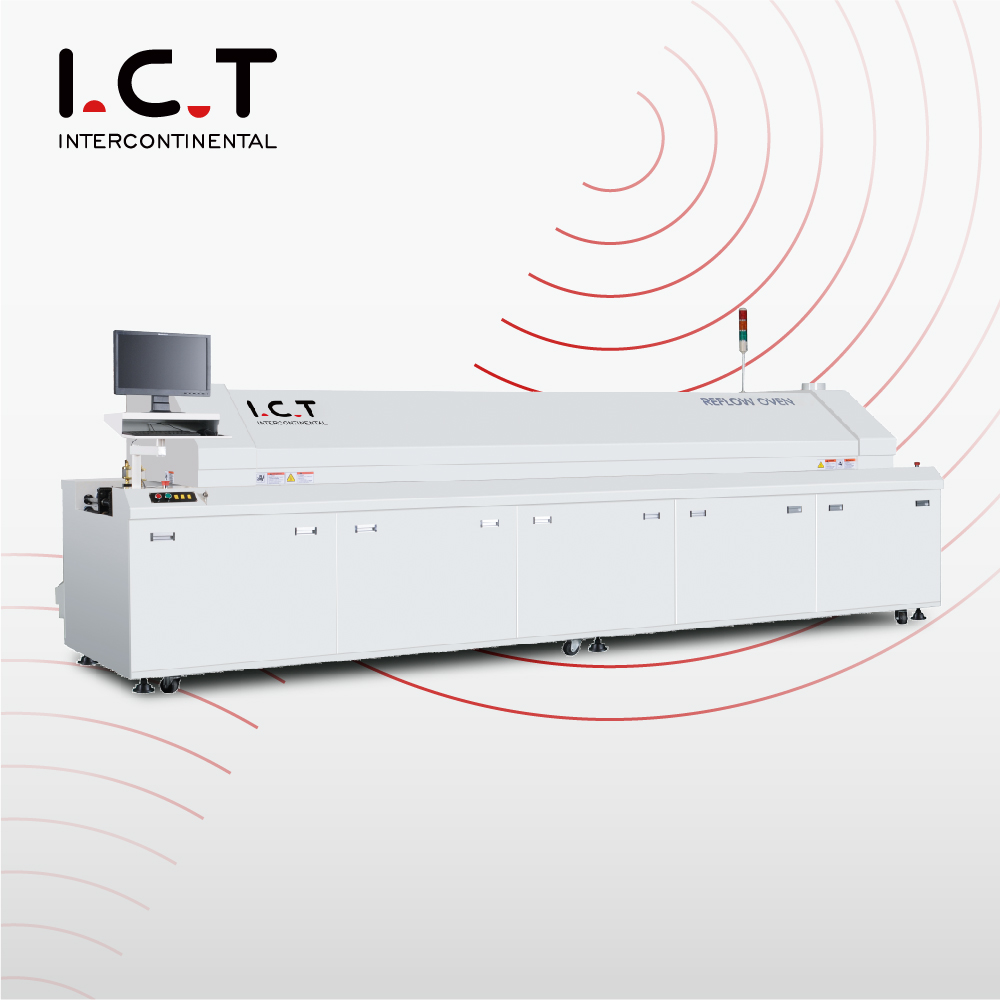
Infrared Oven
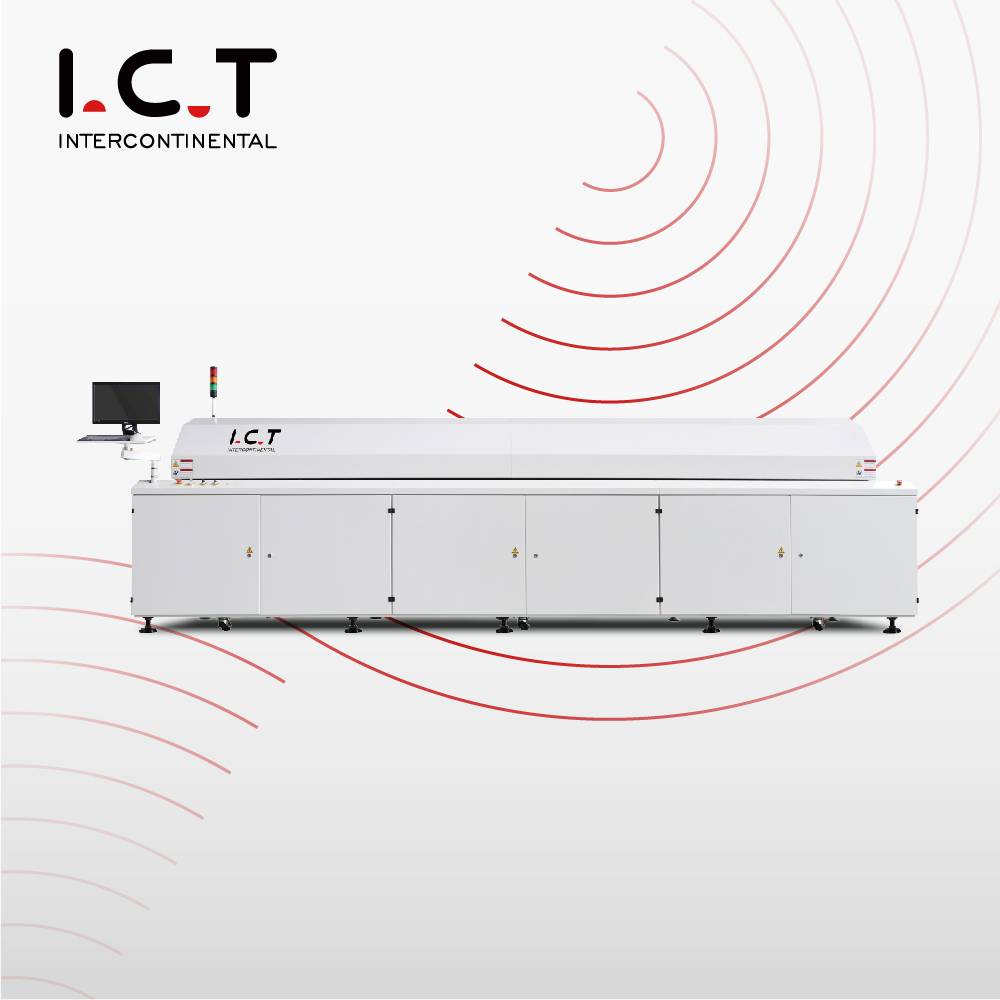
Nitrogen Ovens
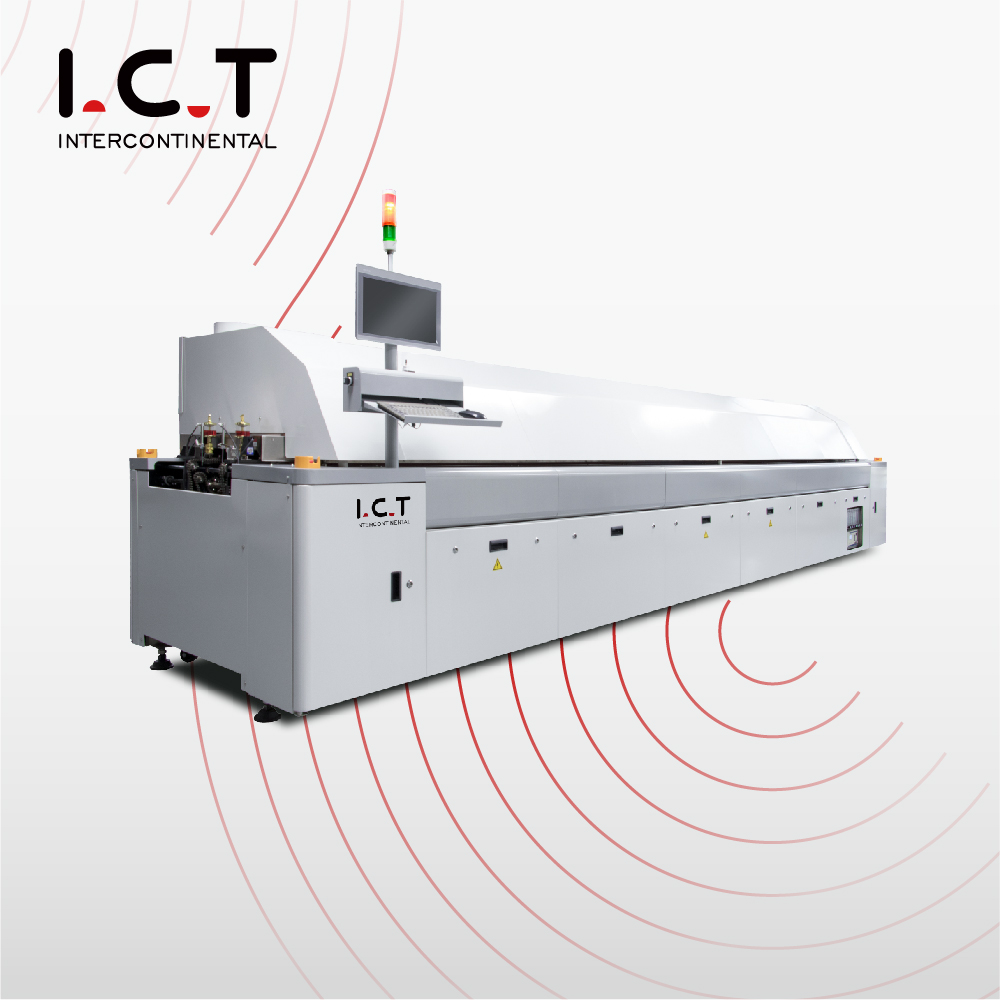
Vacuum Ovens
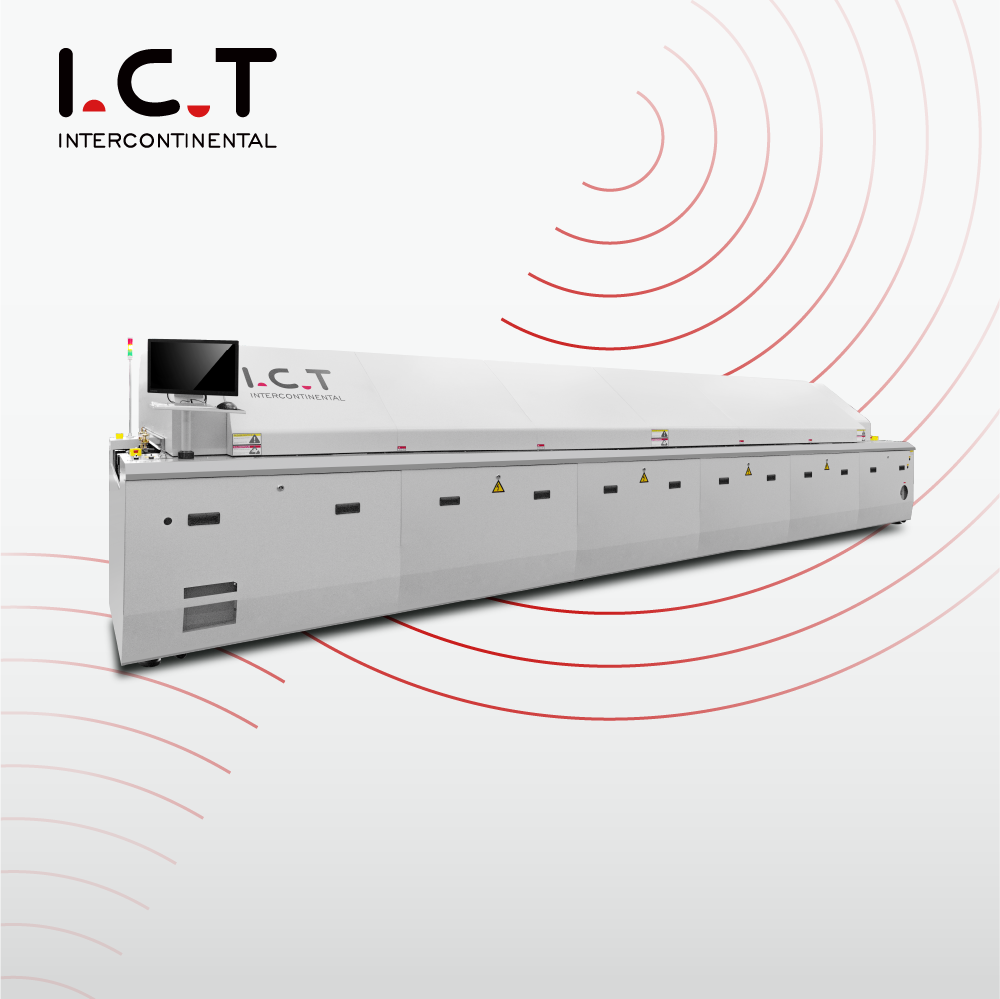
Single Ovens
3.1. Convection vs. Infrared Reflow Ovens
Convection reflow ovens, the industry standard, use hot air to transfer heat evenly, ideal for complex PCBs. Infrared ovens, less common today, rely on radiant heat but can cause uneven heating on dense boards. At I.C.T, we focus on convection ovens like the L8, which offer superior uniformity and energy efficiency, aligning with modern SMT demands.
3.2. Nitrogen and Vacuum Reflow Ovens
Nitrogen reflow ovens, like our Lyra733N, use a nitrogen atmosphere to reduce oxidation, improving solder joint quality for sensitive components. Vacuum reflow ovens, such as our LV623, incorporate a vacuum stage to eliminate voids in solder joints, critical for high-reliability applications like aerospace. These advanced systems enhance quality but require careful calibration, which our I.C.T team supports through integrated oxygen analyzers and flux management systems.
3.3. Single vs. Dual Rail Systems
Single-rail ovens handle one PCB at a time, suitable for smaller operations, while dual-rail ovens, like our Lyra933D, process two boards simultaneously, doubling throughput. Dual-rail systems are ideal for high-volume production but require wider conveyors (e.g., 680mm in the Lyra933D). We’ve designed our ovens to balance flexibility and efficiency, catering to both high-mix and high-volume SMT lines.
4. Key Features to Look for in a Reflow Oven

4.1. Temperature Control and Precision
Precise temperature control is the backbone of a reliable reflow oven. Variations as small as 2°C can cause defects like incomplete soldering. Our I.C.T ovens use advanced PID controllers to maintain tight tolerances across multiple zones. For instance, the Lyra622 with 8 heating zones ensures temperature uniformity within ±1°C, critical for lead-free soldering, which requires higher temperatures (up to 260°C).
4.2. Conveyor Systems and PCB Compatibility
A robust conveyor system ensures smooth PCB movement and compatibility with various board sizes. Our ovens, like the L8 (460mm single rail), support PCBs up to 440mm wide, while the Lyra933D’s dual-rail design handles two 270mm tracks. This flexibility accommodates diverse production needs, from small IoT devices to large automotive boards. Electronic Design emphasizes that conveyor stability reduces PCB misalignment by 15%.
4.3. Advanced Features: Cooling Zones and Flux Management
Modern reflow ovens include cooling zones to solidify solder joints without thermal stress. Our Lyra733N, with three cooling zones and a standard chiller, ensures rapid, controlled cooling. Flux management systems, like those in our nitrogen ovens, recover excess flux, reducing maintenance and environmental impact. These features enhance uptime and sustainability, key concerns for high-throughput SMT lines
5. I.C.T Reflow Oven Solutions
5.1. Overview of I.C.T’s Reflow Oven Portfolio
As a trusted reflow oven manufacturer, we at I.C.T offer a range of solutions tailored to SMT needs. Our portfolio includes standard, nitrogen, dual-rail, and vacuum reflow ovens, each designed for precision, efficiency, and scalability. From compact models for small-scale production to advanced systems for high-reliability applications, our ovens meet diverse industry demands.
5.2. Highlighting Models: L8, Lyra622, Lyra733N, Lyra933D, and LV623
Our L8 and Lyra622 feature 8 heating zones and 2 cooling zones with a 460mm single rail, ideal for mid-volume production with 440mm mesh belts. The Lyra733N, a 10-zone nitrogen oven with 3 cooling zones, includes a chiller, flux recovery system, and oxygen analyzer for high-quality soldering. The Lyra933D, a 12-zone dual-rail oven with a 680mm belt, maximizes throughput for high-volume lines. For specialized needs, our LV623 nitrogen vacuum reflow oven (8 heating zones, 1 vacuum zone, 3 cooling zones) handles PCBs from 150x150mm to 400x400mm, reducing voids for critical applications. These models reflect our commitment to innovation and reliability.
6. Benefits of Using Reflow Ovens in SMT

6.1. Improved Solder Joint Quality
Reflow ovens deliver consistent heat, ensuring strong, uniform solder joints. Our I.C.T ovens, with precise thermal profiles, reduce defects like voids or cracks, critical for high-density PCBs. Industry reports from IPC show that automated reflow processes improve joint reliability by 40% compared to manual soldering.
6.2. Enhanced Production Efficiency
Automation in reflow ovens speeds up soldering, enabling high-volume output. Our dual-rail Lyra933D, for instance, processes two PCBs simultaneously, cutting cycle times by up to 50%. This efficiency is vital for meeting tight production schedules in industries like consumer electronics.
6.3. Reducing Defects with Automated Precision
Manual soldering risks human error, but reflow ovens like our Lyra733N use automated controls to minimize defects. Features like oxygen analyzers in nitrogen ovens reduce oxidation-related issues, cutting rework costs.
7. Choosing the Right Reflow Oven for Your SMT Line
7.1. Matching Oven Specifications to Production Needs
Selecting a reflow oven requires aligning specifications with production goals. For high-mix, low-volume lines, our L8 offers flexibility for diverse PCBs. High-volume manufacturers benefit from the Lyra933D’s dual-rail design. Consider PCB size, component density, and soldering requirements (e.g., lead-free vs. leaded) when choosing. Our I.C.T team provides tailored consultations to match ovens to specific needs.
7.2. Considerations for High-Mix vs. High-Volume Production
High-mix production needs ovens with adjustable settings for frequent changeovers, like our Lyra622. High-volume lines prioritize speed and capacity, making the Lyra933D ideal. Balancing changeover time and throughput is key.
7.3. Balancing Cost and Performance
While advanced ovens like our LV623 offer premium features, budget-conscious manufacturers can opt for cost-effective models like the L8. We at I.C.T ensure all our ovens deliver high performance, with features like PID controllers and robust conveyors, providing value without compromising quality.
8. Summary of Key Points
8.1. Recap of Reflow Oven Essentials
Reflow ovens are critical for SMT, enabling precise soldering through controlled heating zones. They come in types like convection, nitrogen, and vacuum, each suited to specific needs. Key features include temperature precision, conveyor compatibility, and advanced options like flux management. Our I.C.T ovens, from the L8 to the LV623, offer tailored solutions for quality and efficiency. Choosing the right oven involves matching specifications to production demands, ensuring reliable, high-quality PCB assemblies.
For tailored advice on selecting or maintaining a reflow oven, contact us at market@smt11.com. At I.C.T, we’re committed to powering your SMT success with cutting-edge solutions.