
The Ultimate Guide to Choosing the Right SMT Printer for Your SMT Line

As manufacturers of high-quality SMT printers at I.C.T, we know that selecting the right equipment can transform your PCB assembly line from bottleneck to powerhouse. The key lies in matching printer capabilities to your specific production demands, ensuring seamless integration and optimal performance right from the start. For instance, advanced SMT screen printing technology forms the foundation of precise solder paste application, directly impacting yield rates and product reliability.
1. Understanding SMT Printer Basics in Modern PCB Assembly

1.1. Core Functions of an SMT Printer
We at I.C.T design our SMT printers to handle the critical first step in surface mount technology: depositing solder paste onto PCB pads with pinpoint accuracy. This process involves a stencil, squeegee blades, and automated alignment systems that ensure even paste distribution. Without a reliable printer, downstream issues like component misalignment or poor soldering joints become inevitable. Our machines automate this to minimize human error, supporting high-speed operations where manual methods fall short.
The printer aligns the stencil over the PCB, applies pressure via squeegees to force paste through apertures, and then separates cleanly to leave uniform deposits. We incorporate features like automatic stencil cleaning and paste inspection to maintain consistency across thousands of cycles. This core function sets the stage for pick-and-place accuracy, making it essential in any modern assembly environment.
1.2. Integration Points in Full SMT Lines
In a complete SMT line, we position our printers immediately after board loading and before placement machines. This sequencing allows for real-time feedback loops, where SPI (solder paste inspection) units verify deposits before components are placed. We ensure our printers communicate via SMEMA standards, enabling smooth handoffs to conveyors, ovens, and AOI systems.
For lines incorporating DIP, coating, or dispensing, we build in flexible interfaces. Our printers adapt to varying board thicknesses and support inline buffering. This integration reduces downtime and allows operators to monitor the entire line from a central console, a feature we prioritize in all I.C.T models to streamline workflows in diverse manufacturing setups.
1.3. Evolution from Manual to Fully Automatic Systems
Early SMT printing relied on manual stencil alignment and hand-operated squeegees, which we now view as relics in high-volume production. We transitioned our designs through semi-automatic phases with basic vision aids to today’s fully automatic printers equipped with AI-driven corrections. This evolution cuts setup times from hours to minutes and boosts repeatability to sub-micron levels.
Modern I.C.T printers feature touchscreen interfaces, recipe storage for quick changeovers, and predictive maintenance alerts. We have seen customers upgrade from legacy systems and achieve 30-50% throughput gains, proving how automation addresses labor shortages and quality demands in competitive markets.
2. Key Specifications to Evaluate in SMT Printers

2.1. PCB Size Compatibility and Handling
We engineer our SMT printers to accommodate a wide range of PCB dimensions, crucial for versatile production. Maximum sizes vary by model, but we focus on stable support frames that prevent warping during printing. For example, edge clamping and vacuum support ensure flatness even on thin flex boards.
Handling includes automatic board positioning, warpage compensation, and dual-lane options for parallel processing. We recommend evaluating minimum and maximum sizes against your product portfolio to avoid future limitations. Oversized printers offer future-proofing but require more floor space, a balance we help customers strike during consultations.
2.2. Printing Accuracy and Repeatability Metrics
Accuracy in solder screen printing measures how precisely paste lands on pads, typically ±25 microns or better in our high-end models. We achieve this through closed-loop vision systems that detect fiducials and adjust in real-time. Repeatability ensures consistent results across runs, vital for fine-pitch components like 0.4mm BGA.
We test under IPC-9850 standards, reporting CpK values above 1.33 for process capability. Factors influencing accuracy include stencil tension, squeegee pressure, and environmental controls. Our printers log these metrics for traceability, helping identify drifts before they cause defects.
2.3. Cycle Time and Throughput Capabilities
Cycle time defines how quickly a printer completes one board, directly affecting line throughput. We optimize ours to under 10 seconds including alignment and printing, enabling rates over 360 boards per hour in optimal conditions. Dual squeegee heads and parallel processing cut idle times.
For high-volume lines, we incorporate buffer systems and fast stencil loading. Throughput scales with PCB complexity; simpler boards run faster. We provide simulation tools to model your line’s UPH (units per hour) based on printer specs, ensuring the machine paces the rest of the equipment without creating bottlenecks.
2.4. Solder Paste Management Features
Effective paste management prevents drying, contamination, or waste. We equip our printers with enclosed paste rolls, automatic dispensing, and stirring mechanisms to maintain viscosity. Sensors monitor paste height and trigger refills, reducing operator intervention.
Temperature-controlled reservoirs handle various paste types, from no-clean to water-soluble. We include rollback functions to reuse excess paste and cleaning cycles that minimize consumption. Proper management extends stencil life and ensures consistent print volumes, critical for yield optimization.
2.5. Vision and Alignment Systems
Advanced vision is non-negotiable in precise printing. Our systems use high-resolution cameras to capture multiple fiducials, calculating offsets for X, Y, and theta adjustments. 2D inspection verifies paste after printing, flagging bridges or insufficiencies inline.
We offer upgrades to 3D SPI integration for height measurement, ensuring volume accuracy. Lighting and algorithm tweaks handle reflective surfaces or colored soldermasks. This technology adapts to board variations, maintaining alignment even with warped PCBs up to 5mm.
3. Matching Printer Models to Production Needs

3.1. Small to Medium Volume Operations
For prototype or low-volume runs, we suggest compact printers with easy setup and manual overrides. These handle PCBs up to 400x340mm efficiently without overwhelming floor space. Quick changeover features support frequent job switches, ideal for job shops or R&D facilities.
We include user-friendly software for recipe creation, allowing operators to store hundreds of profiles. Energy-efficient designs keep operating costs low, and modular builds permit upgrades as volume grows.
3.2. High-Volume LED Bulb Assembly Lines
LED production demands long PCBs and rapid cycles. We tailor printers for extended lengths like 1200mm, with reinforced frames to maintain accuracy over large areas. High-speed modes prioritize throughput while preserving fine-pitch capability for drivers and chips.
Integration with automated loading for bulb panels streamlines flow. We focus on dust-free environments to avoid contamination on phosphor coatings, incorporating HEPA filters where needed.
3.3. Versatile Lines with DIP and Coating Integration
Multi-process lines require printers that bridge SMT and through-hole stages. We design for seamless transitions, supporting mixed technology boards. Buffer zones and recipe linking ensure DIP inserters receive properly printed PCBs.
Coating compatibility means non-interference with conformal layers post-reflow. Our printers output data for traceability across processes, aiding quality control in complex assemblies.
3.4. European Standard Compliance for Global Markets
We certify our printers to CE and other EU norms, featuring safety interlocks and ergonomic designs. PCB sizes up to 510x510mm meet mainstream standards, with precision suiting automotive and medical sectors.
Compliance extends to software validation and documentation, simplifying audits. We provide multilingual interfaces and support for global installations.
4. I.C.T Printer Models: Tailored Solutions for Diverse Applications
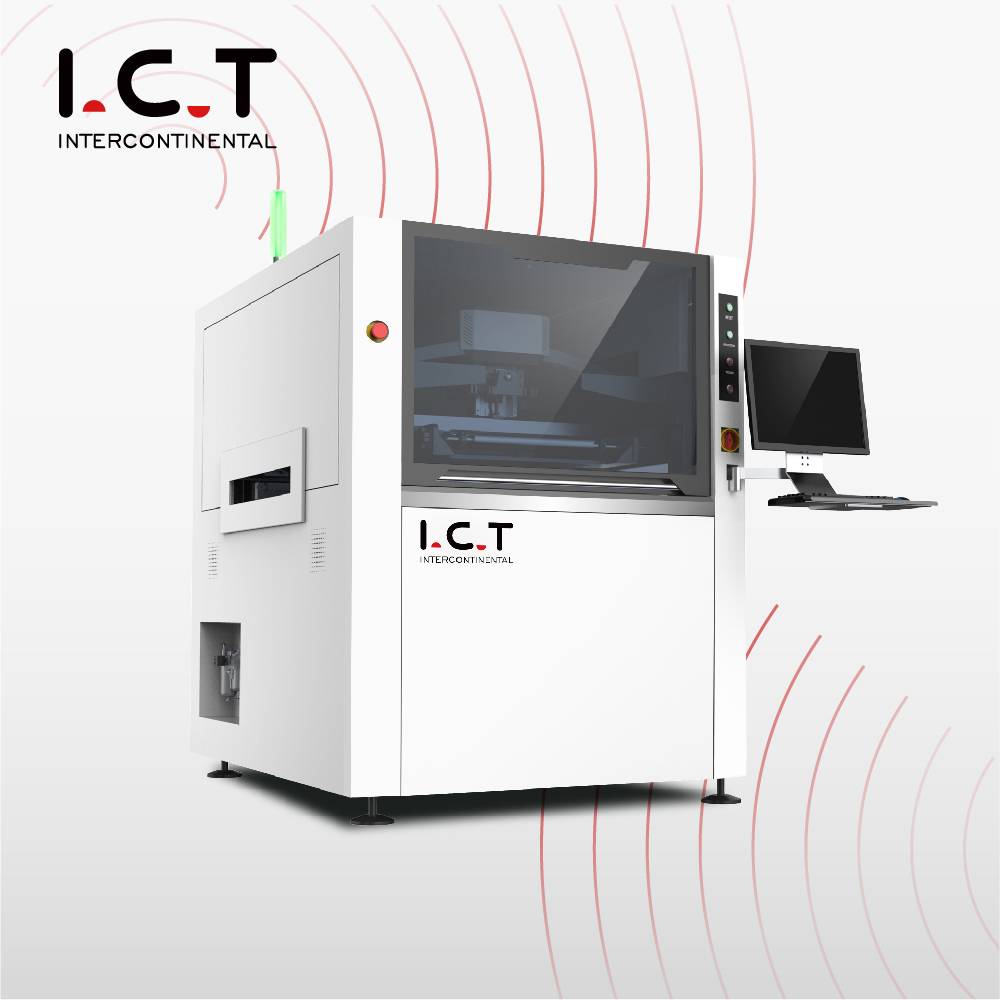

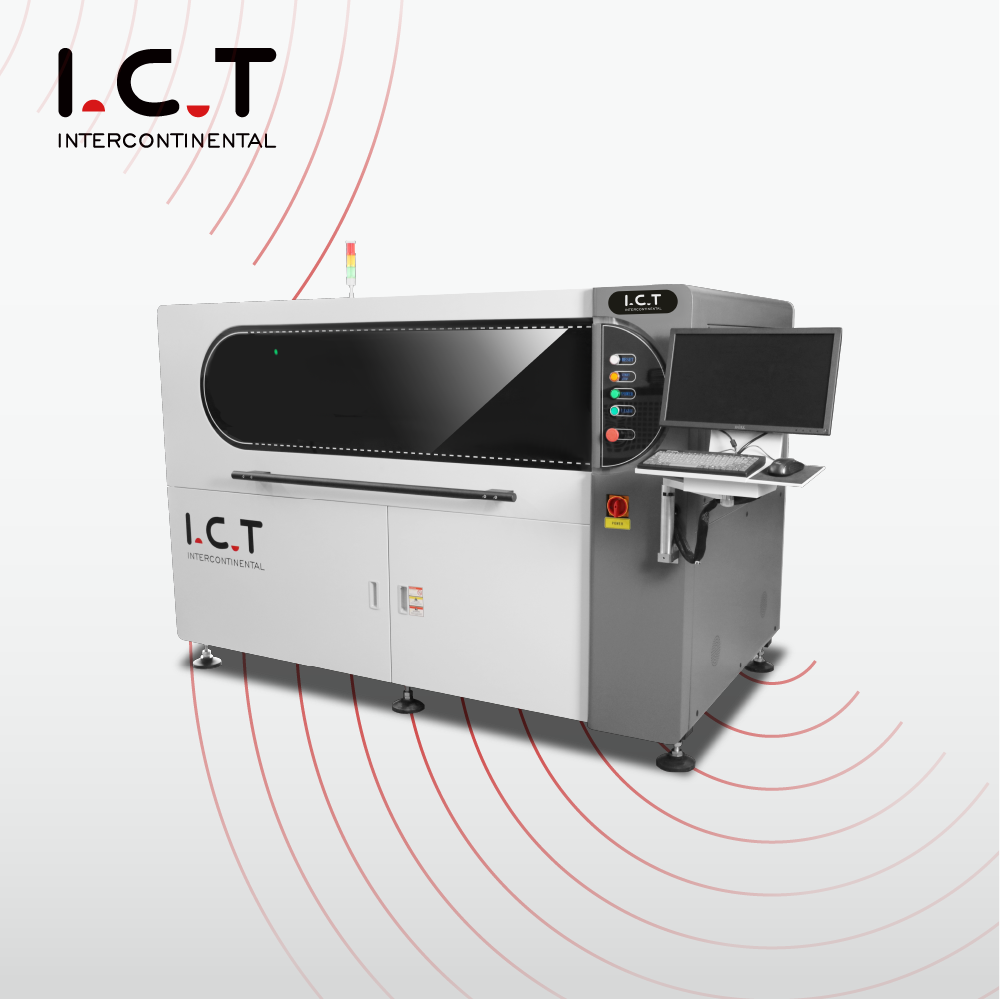
4.1. I.C.T-4034 for Compact Yet Flexible Setups
We developed the I.C.T-4034 for lines needing reliability in limited space, supporting PCBs up to 400x340mm. Its core alignment accuracy reaches ±20 microns, with cycle times under 8 seconds. Automatic features include stencil wiping and paste inspection.
This model excels in multi-line configurations, as seen in customer deployments with DIP and coating extensions. We build it with a robust frame for 24/7 operation, including remote diagnostics.
4.2. I.C.T-5151 for Euro-Standard High-Precision Lines
Compliant with European benchmarks, the I.C.T-5151 processes 510x510mm PCBs with ±15 micron accuracy. We integrate advanced 2D/3D inspection and AI correction for ultra-fine pitches.
Its modular design allows inline SPI and buffer additions. We prioritize energy efficiency, consuming 20% less power than competitors in similar classes.
4.3. I.C.T-1200 for Extended PCB Lengths in LED Production
The I.C.T-1200 handles PCBs up to 1200x350mm, perfect for LED strip or bulb panel printing. We incorporate elongated conveyors and segmented support to prevent sagging. Throughput exceeds 300 boards per hour in LED modes.
Vision systems manage long-distance fiducials, ensuring end-to-end accuracy. We add specialized squeegees for viscous pastes used in high-power LEDs.
5. Real-World Case Studies from Global Customers
5.1. Tajikistan: Multi-Line Deployment with I.C.T-4034
A Tajikistan manufacturer expanded with two SMT lines, one DIP, one coating, one dispensing, and one LED bulb assembly line. We supplied I.C.T-4034 printers handling 400x340mm PCBs. The compact size fit their facility, and integration enabled synchronized multi-process flow.
Post-installation, they reported 95% first-pass yields and reduced setup times by 40%. Our on-site training ensured quick ramp-up, supporting their growth into export markets.
5.2. Saudi Arabia: LED Bulb Focus Using I.C.T-1200
For LED bulb production in Saudi Arabia, the client purchased a full SMT line featuring our I.C.T-1200 printer for 1200x350mm PCBs. The extended length accommodated panelized bulb designs, boosting output to 500 units hourly.
We customized paste management for hot climates, preventing drying issues. The result: consistent phosphor adhesion and fewer reflow defects, validated by their ISO certifications.
5.3. Uzbekistan: Full SMT Line with I.C.T-5151
An Uzbekistan customer built a fully automatic SMT line around our I.C.T-5151, processing 510x510mm Euro-standard PCBs. Precision alignment supported dense automotive electronics assemblies.
Line integration with pick-and-place and reflow yielded 98% uptime. We provided software links for MES systems, enabling data-driven optimizations that cut waste by 25%.
6. Maintenance and Long-Term Reliability Factors
6.1. Daily Cleaning and Calibration Routines
We recommend daily stencil underwipe with approved solvents and squeegee checks. Our printers automate much of this, with programmable cycles. Calibration involves fiducial checks and pressure verification, taking under 5 minutes.
Regular routines prevent paste buildup, extending component life. We supply kits and guides to make this straightforward for operators.
6.2. Software Updates and Diagnostic Tools
We release firmware updates quarterly, adding features like enhanced algorithms. Built-in diagnostics flag issues via error codes and predictive analytics based on usage data.
Remote access allows our engineers to troubleshoot globally, minimizing downtime to hours instead of days.
6.3. Spare Parts Availability and Support
We stock critical parts like squeegees and stencils worldwide, with next-day shipping in many regions. Our support includes 24/7 hotlines and extended warranties up to 5 years.
Modular designs enable field swaps without full shutdowns, ensuring reliability in continuous operations.
7. Cost Considerations and ROI Analysis
7.1. Initial Investment vs. Operational Savings
While premium printers require upfront capital, we calculate ROI through reduced defects and labor. Customers often recoup costs in 12-18 months via higher yields and less rework.
We offer financing and trade-in programs to ease entry, focusing on total cost of ownership rather than sticker price.
7.2. Energy Efficiency and Consumables Costs
Our printers use servo motors and LED lighting for lower power draw. Optimized paste usage cuts consumables by 15-20% compared to older models.
Longer intervals between cleanings reduce solvent and wipe expenses, contributing to sustainable operations.
7.3. Scalability for Future Line Expansions
We design with upgrade paths, adding lanes or vision modules without full replacements. This protects investments as production scales from thousands to millions of units annually.
Software compatibility ensures new lines integrate seamlessly with existing I.C.T equipment.
8. Summary of Key Points
Choosing the right SMT printer involves assessing PCB sizes, accuracy needs, throughput, and integration. We at I.C.T offer models like the 4034 for flexibility, 1200 for LED lengths, and 5151 for precision standards. Real cases in Tajikistan, Saudi Arabia, and Uzbekistan demonstrate reliability and ROI. Prioritize maintenance, cost factors, and scalability for long-term success


